So before starting my Holga shoot I did some research to try and get some ideas as to what I wanted to shoot. I came across the Flickr account of "rockpool73" and was immediatly inspired. (I would post some of his pictures, but Flickr won't allow it.) My favorite thing about the photographer's pictures was the heavy blacks he got in his pictures. This appeared most in afew picture he took of a long haired cat. Seeing this brought me back to a subject I'd tried many times to shoot, but had never been able to capture: my cat. Shooting my cat is always very difficult because he's very needy, and when I bend down to take his picture, he immediately runs over to me. I decided that I would try again. First I brought Montey (my cat) inside, and had my dad pet him to try and keep him still, but then I became leary of shooting indoors and decided it might be cool if I took him into the woods. He dutifully followed me into the backyard, but when we got into brush he'd bight at things and groom himself (neither actions made for a good picture). I also found that since I was shooting first thing in the morning, the sun was really strong, and it was having a negative affect on the pictures I took. I tried for about an hour, to get at least one picture I liked, but I had no luck.
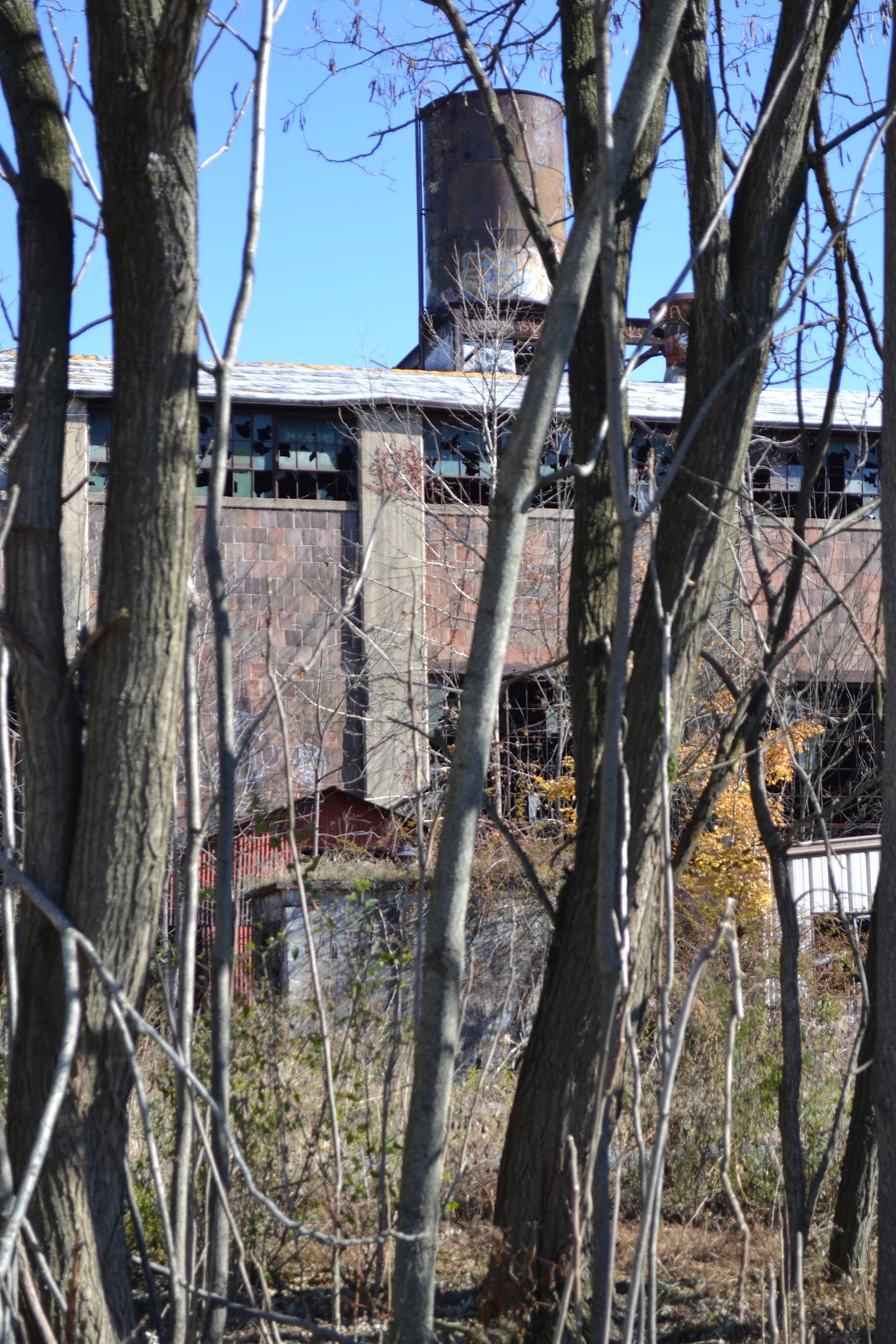
Feeling semi discouraged, I moved to plan B: I asked my mom to drive me to an abandoned factory I'd seen by a place I used to volunteer at. She happily agreed, but when we got there I realized this may not have been such a good idea. The factory was gigantic, and no one but my mom and I were around. The factory would probably be a good place for my town's homeless people to live. I became terrified at the idea of an angry stranger bursting out of the building. My mom (who in some ways is my complete opposite) didn't really consider this fear at all, she was excited and wanted to explore. As I slowly walked toward it I noticed "no trespassing" signs all over the place, and graffiti everywhere; what if this was a gang hangout?! I had my DSLR with me and did not want to be held up. Once again, my mom thought I was being ridiculous, and yelled to me to come closer. I eventually did, and saw that the inside of the factory was really awesome, but the ground inside was completely torn up, and amidst all the decay was a running pump. This planted another fear in my mind; what if this was a hazardous waste site? Once I thought of this I decided it was time to go. I took afew more pictures, and we left. The whole setting was really strange, but it was so much fun to shoot. While I was kinda proud of myself for semi-conquering my fear of the building, I found that my fear made it hard for me to focus on the composition of my pictures, and when I looked back on the ones I took digitally a lot of them weren't level.
So here are some of the pictures I took throughout my morning of shooting. I shot the pictures of my cat and the woods with the Hipstamatic because I thought it might better imitate what the Holga pictures would look like, but the factory pictures are from my DSLR.
If you want to see rockpool73's awesome pictures here's the link!
http://www.flickr.com/photos/rockpool73/5403907762/in/photostream
Sunday, November 6, 2011
Saturday, October 29, 2011
Neal Casal Photography
Neal Casl, (a family friend) works as a guitarist (he is currently touring with The Chris Robinson Brotherhood), but is also a terrific photographer. My favorite thing about Neal's photos is that while he shoots digitally his pictures are very contrasted and he always has a solid black and white in his pictures. Also, since he is a musician he encounters a lot of really cool things that, someone outside of the music business/someone not touring the country wouldn't ordinarily get to see.
Neal also works in two of my favorite genres of photography: portraiture and documentation. Although couldn't it. He took an awesome portrait of Norah Jones in a recording studio. She doesn't know he's taking the picture, but she looks completely at home with the music she's listening to. You can see the reflection of a bunch of musicians in the background of a window she's standing in front of. He also took an amazing photo from back stage of Amanda Shire as she places her violin for hundreds of people. While the crowd is obviously visible, her and her violin are the focal point, and it's obvious that the music is really all that matters. If you get the chance, you should check out his music and his photography!
http://www.nealcasal.com/photo/gallery.php
12 Queries response
When I learned that we had to read something for photo class, I immediately recalled reading "the history of photography", and began to dread reading the "12 Queries for Aspiring Imagemakers" by Robert Hirsh. However when I started reading it I found that I actually really enjoyed it. Many of the questions asked in the article are questions that I struggle to answer myself, so to have a written answer to all of them was comforting. I knew I would like the article after reading question one and it's response: "Who is an artist?" Whenever I take pictures I think about this question. I like to take pictures, but I don't consider myself by any means to be an artist. My ideas about my "non artistry" were kind of reaffirmed this summer. I wanted to play with different mediums of art so I started to learn to sew. (I'm in the process of finishing my second skirt), and I also took a weekly ceramics class at NCAC. I loved doing both, but I felt kind of defeated one night when one of the expert potters declared that you were not an artist if you couldn't draw. I cannot draw at all. As I thought about it, I began to agree with the potter's idea. In order to draw you need to be able to see well. I can't see well physically or mentally. Aside from my drawing ineptitude, I've never really felt that I have the amount of passion needed to be considered "an artist." With these ideas in mind, I was really surprised to hear Hirsch declare that "An artist is a person who had decided to create an artist." I love this idea because it doesn't set restrictions on people. According to Hersh an artist is not a label or an occupation, but a mentality. While I still don't consider myself an artist, this definition helped me to feel that the door is always open if I want to be.
Another of my favorite queries was the honest statement, that I've thought a million times over: "There is nothing to make an interesting pictures about in Buffalo." While I obviously don't live in Buffalo, my town contains nothing but strip malls, and burger joints. Finding anything that is even "wabi sabi beautiful" has become increasingly harder. Hirsch presents a new view point on this problem when he states "pictures that affect us have nothing to do with the apparent subject matter, and everything to do with the subsequent treatment of that matter." I think I always thought is subconsciously, but I never fully realized that a picture is not about the subject, but more about what the subject is saying. This idea was the best piece of advice I came away with after reading the article.
My biggest problem was the article was that I felt like some of the answers weren't fully answered. Sometimes it seemed as though Hirsch recited the question instead of answering it. This was most apparent and frustrating to me in the question "How can I learn to "see"?" Hirsch's language was hard to follow, and I couldn't find a sentence in his answer that was an evident answer to the question. I found his language kind of intimidating, and it brought me back to my original dilemma. I found myself thinking 'I must just not be artistic enough to understand his abstract responses.'
Another of my favorite queries was the honest statement, that I've thought a million times over: "There is nothing to make an interesting pictures about in Buffalo." While I obviously don't live in Buffalo, my town contains nothing but strip malls, and burger joints. Finding anything that is even "wabi sabi beautiful" has become increasingly harder. Hirsch presents a new view point on this problem when he states "pictures that affect us have nothing to do with the apparent subject matter, and everything to do with the subsequent treatment of that matter." I think I always thought is subconsciously, but I never fully realized that a picture is not about the subject, but more about what the subject is saying. This idea was the best piece of advice I came away with after reading the article.
My biggest problem was the article was that I felt like some of the answers weren't fully answered. Sometimes it seemed as though Hirsch recited the question instead of answering it. This was most apparent and frustrating to me in the question "How can I learn to "see"?" Hirsch's language was hard to follow, and I couldn't find a sentence in his answer that was an evident answer to the question. I found his language kind of intimidating, and it brought me back to my original dilemma. I found myself thinking 'I must just not be artistic enough to understand his abstract responses.'
Chris Keeney
Taken by Chris Keeney using an Arturo Fuentes Exuisitos Wooden Cigar Box Pinhole Camera
Taken by Chris Keeney using a coffee can pin hole camera.
When given the assignment to blog about an experimental photographer I had no idea who I wanted to talk about, thank goodness I stumbeled upon Chris Keeney's blog. Not only is Keeney a fantastic portrait photographer, but he also loves to build and shoot with pinhole cameras and Holgas!
My favorite aspect of Keeney's pictures is the blur that occurs as the result of his shooting with his pinhole. You can obviously tell what his subject is, but the blurs and light leaks give his pictures a vintage quality that I love. Another characteristic I've found I admire in pin hole pictures is their quiet meticulousness. There is so much work that goes into taking pin hole pictures, and for him to get even one of his shots to come out so perfectly is just amazing to me.
A great part of Keeney's blog is it's not only personable (he describes himself as a photographer who "like[s] to wear shorts, t-shirts, flip-flops, sneakers, hoodies and comfortable jeans"), but also the advice he gives in relation to different types of film, and cameras. I encourage everyone to go check out his blog!
http://chriskeeney.com/
Tuesday, October 25, 2011
Hipstamatic
Over the summer I struggled with photography. I wanted to take pictures, but I also wanted to be involved what was going on around me. (I usually chose the latter.) When I did take pictures, I was never happy with them. They were bland, and didn't completely capture what I wanted. Hipstamatic got rid of my bored feelings toward photography, and got me to start taking pictures on a regular basis again. I like Hipstamatic because you never quite know what your results will be. It makes photography exciting, and makes everything completely beautiful.The application has encouraged me to want to photograph everything I encounter. It's made me much more aware of my surroundings, and has (I think) given me a new understanding of wabi sabi in that I now appreciate a lot of the "boring" places I used to overlook.
Recently my parents and I met up with some family friends I felt completely disconnected to. I hadn't seen them since I was very little, and only remembered one. When we arrived I sat quietly waiting for something to come along in conversation that I could contribute to. My mom brought up photography, and it turned out that one of the guys loved the hipstamatic. I ended up spending the whole "get-together" with him, as he showed me pictures he'd taken, and gave me advise on good film to use etc. He also showed me another application called the Tilt-Shift-Generator, which allows the photographer to add more depth of field to his or her pictures/let's the photographer chose and strengthen his or her focal point. It was so much fun to talk with someone who blatenly appreciated the app. as much as I do. I think it's great that so many people use the Hipstamatic because it gives quasi-photographers an outlet to have fun taking picutes, but also because--as I learned-- it can bring people together. (I know that statement sounds like total cheese, but I think it's true.)
While I love the application, I hate the name "Hipstamtic." I don't understand what makes anything (especially a photograph) hipster. To me, the whole idea of hipster just seems like another label people use to help them identify each other. It might sound lame, but I prefer to think of Hipstamatic as a toy camera application. As with other toy camera's it's cheap, and the photographer still must make choices to get the picture he or she wants. Hipstamatic even has stimulated light leaks that occur often with normal toy cameras.
Friday, October 21, 2011
The AMAZING Bill Cunningham
If I had to chose a photographer role model it would be Bill Cunningham. After watching Bill Cunningham New York I found myself in awe of him. A Harvard dropout turned fashion documentarion, Cunningham has been shooting fashion since the 40s. He makes clear that he does not care about celebrities, he'll shoot anyone if he finds their clothing interesting. My favorite thing about Cunningham is his abhorrence towards money. Although he works for the New York times and is considered one of the best photographers of this generation, he refuses to take a large paycheck because he feels it gives others power over his work. He has never owned a television and lives in a tiny apartment filled solely with filing cabinets full of negatives and a small bed wedged in between. He doesn't own a kitchen and uses his apartment's public bathroom to shower. Cunningham truly lives his work. He bicycles around the city and stands on street corners shooting people as they walk by. He uses his pictures in his weekly New York Times print in which he cuts and pastes images together on a single page all involving a certain trend he noticed that week.
Another great quality of Cunningham's is his egalitarian outlook. Cunningham treats everyone as equals and only portrays people in a positive light (no pun intended). Anything from a drag queen to a sharply dressed business woman is beautiful in Cunningham's mind. If he doesn't find one's clothing artful, he doesn't take a picture of it. As mentioned earlier he has no interest in celebrities, and keeps his photos tied to the common individual. Even when shooting Runway shows, he only takes pictures of something he believes someone will wear.
In Bill Cunninham New York one is able to fully see the love he has not only for photography--he claims to "eat with his eyes", but his love for his subject also. He begins to cry when he declares in a speech that whoever thinks fashion is declining is ridiculous; fashion is as brilliant as ever. Cunningham introduced me to a new level of love; I've never seen anyone so enamored by their job. I admire him completely. I encourage everyone to check him out in the fashion section of the New York Times!!
Previous Cunningham pages:
Cunningham's one room apartment
P.S. I forgot to mention that Cunningham continues to shoot in color film!
Another great quality of Cunningham's is his egalitarian outlook. Cunningham treats everyone as equals and only portrays people in a positive light (no pun intended). Anything from a drag queen to a sharply dressed business woman is beautiful in Cunningham's mind. If he doesn't find one's clothing artful, he doesn't take a picture of it. As mentioned earlier he has no interest in celebrities, and keeps his photos tied to the common individual. Even when shooting Runway shows, he only takes pictures of something he believes someone will wear.
In Bill Cunninham New York one is able to fully see the love he has not only for photography--he claims to "eat with his eyes", but his love for his subject also. He begins to cry when he declares in a speech that whoever thinks fashion is declining is ridiculous; fashion is as brilliant as ever. Cunningham introduced me to a new level of love; I've never seen anyone so enamored by their job. I admire him completely. I encourage everyone to check him out in the fashion section of the New York Times!!
Previous Cunningham pages:
Cunningham's one room apartment
P.S. I forgot to mention that Cunningham continues to shoot in color film!
Monday, October 10, 2011
My thoughts on Kurt (a jumble I know)
My admiration for Kurt Cobain is complicated. I'm not really into punk nor have I ever listened to Bleach, but I still consider myself a legit fan. When I tell people that Kurt's my biggest inspiration they kind of chuckle to themselves; some think that admiring a suicidal drug addict is weird--I see no problem with it. It's hard to express why I like Kurt so much, all I can say is that listening to his music makes me feel calm. Although I know he didn't like people reading into his lyrics, I think he's a brilliant writer. His song "Dumb" is probably one of my favorite songs of all time. In it he talks about the crap serious parts of life, and then talks about his happiness. I've always felt like he's saying "you shouldn't be happy when life is a mess, but I'm gonna do it anyway" For me, when something goes wrong in my life I let it bog me down. When I listen to Dumb I'm reminded that no one is able to officially label something "dumb" or "wrong." On some level, the song even makes me reacess what being dumb even means. Some may view Kurt as dumb; I don't think so.
I began admiring Kurt two summers ago when I read his journals. My favorite section is when he writes "our party gathers out of boredom. Role playing for affection and acceptance and to disinfect nagging germs ending in silence." Once again, he managed to describe feelings I could completely relate to, especially since I'm still in high school. There are a lot of days where I think people fake themselves, and hang around together just to seem cool and understood. I know I've done it before. I guess my favorite aspect of Kurt is that he's able to look at these actions from afar and describe what someone is really doing. He's able to identify the horrible and manipulative parts of life and explain them.
Outside of liking Kurt I like this portrait of him too. I think shooting (or editing) it to be black and white was a brilliant idea. The colors allow the eye to focus solely on him and his guitar, which, on some level was really all he cared about.
I feel trying to write my feelings about someone I admire so much kind of underscores my appreciation of him. I'm sure some of what I've just written may come off as naive, stupid, or wrong. Oh well. I hope this entry made some semblance of sense.
Subscribe to:
Posts (Atom)